The World’s Favourite MRI Course, based on the World’s Best-Selling MRI Book
Why Choose MRI in Practice - The Course?
Why Choose MRI in Practice - The Course?
Make an Informed Decision:
We are very aware that you have a choice when it comes to CPD and MRI courses. If you are a manager, you will be looking to make a clear evidence-based decision on which course can get your new staff up-to-speed with MRI within your training budget. If you are a radiographer, looking to fulfil CPD requirements, or wish to learn the underpinning principles of MRI in a format that is applied to your day-to-day work, then please consider the following points.
We invite you to scrutinise our credentials and compare them to any other course available because we are confident that our MRI course ticks all the boxes.
Reputation and legacy
Presenters who are qualified to teach
Compact & comprehensive programme
CPD NOW endorsement from SCOR UK
State-of-the-art Presentations
Almost 100% delegate satisfaction scores
International Accreditation
What Our Delegates Say
These comments are taken directly from our end-of-course feedback forms, submitted anonymously by delegates after completing the MRI in Practice course.
"Absolutely everything! The online platform is excellent, easy to navigate and makes complete sense. I loved the animations and being able to play through them for revision after the lectures. Being a visual learner, this was just amazing. As speakers you are both very engaging and no word is ever wasted — pure gold! I felt like I was attending a study day even though I knew it wasn't live. Thank you so much for sharing your expertise, I will highly recommend your wonderful course!"— Kathryn, Radiographer
"I found this course very easy to follow. The information-dense subjects and the 3D animations within the lectures were invaluable in solidifying this knowledge. The structure was well laid out and logical in order. I also really liked the interactive nature of the chats with other participants and John and Cathy. This course was honestly invaluable! I will be recommending MRI in Practice to others."— Tara, Radiographer
"Everything seemed really well put together and thought out. Each video lecture, the slides and even the voices were very well articulated and presented. My favourite is still the animated diagrams as they were amazing for revision and helped put an image in my mind for concepts that were hard to grasp, especially in three dimensions."— Bryan, Radiographer
"MRI is very hard to describe and explain with words or equations. Diagrams help but these CGI animations were next level. Concepts that I have struggled with were much easier to grasp with the animations."— Andrew, Radiographer
"I really liked the conceptual approach taken for this course. A lot of MRI material seems to get bogged down in equations and physics, but the use of the analogies and CGI animations makes it very much easier to grasp particular concepts."— Rhys, Radiographer
"The course is extremely organised, especially for an online course. Very easy to navigate and work your way through at a personal pace. I also found the animations were really helpful at being able to visualise the concepts being discussed."— Alexandra, Radiographer
"The graphics and the teaching method — MRI physics is full of abstract things but the use of the graphics made it really easy to learn. A million thanks to John and Catherine for the thorough explanations. My MRI knowledge has improved and will get even better as I read the textbook — I have bought one already!"— Raymond, MRI Radiographer
"The graphics made the subjects come alive, and the book came alive too. I enjoyed the self-paced way of learning and the ability to rewind as necessary. Content was presented in a logical order bringing everything together."— Tracy, Radiographer
"It was very informative and delivered at a good pace. I found it helpful that I could pause the lectures and watch at my own pace. I could see the time and effort put into all of the lectures and the supplementary materials."— Beatrice, Radiation Therapist
"Having more time to watch lectures, pause and re-watch bits was great! Way better than listening live as it allows time to process these very complex concepts. I found the 3D animations and revision sessions super helpful to consolidate the information."— Lucy, Veterinary Diagnostic Imaging Nurse
"The topics were presented in a logical and well-structured manner, with clarity throughout, and I felt well supported by John and Cathy. Thank you!"— Lauren, Radiographer
"As someone who has difficulty concentrating for long periods, it was great that I could pause and re-visit the lectures. The ability to look at lectures in your own time was excellent."— Kiri-Anne, Radiographer
"The animation demystified a lot of complex concepts in MRI for me. The pacing and presentations were excellent."— Kenechi, Radiographer
"I liked that I could watch it multiple times by rewinding. As I am a slow learner I needed to watch some of the topics a couple of times to grasp the concepts."— Leah, Radiographer
"John's subtle humour brought the lectures to life! Those small hints at his great sense of humour not only inspired you to listen and learn — it also fortified the lessons. The presentation graphics were brilliant!"— Emma, Radiographer
"I really liked the graphics during the lectures and the 3D diagrams. I'm a visual learner so it helped me understand some concepts more. I also liked that the revision section stayed up so I could retest my knowledge at the end of the course."— Julia, Radiographer
"I liked the flexibility to watch the lectures at any time during the 24-hour window — meant I could actually walk my dog in the daylight during the day and still spend time in the evening watching the lectures."— Joanne, Radiographer
"Interactive activities and animations were really helpful. Will definitely be recommending it to my colleagues."— Laura, Radiographer
Recognised Academic Rigour
Recognised Academic Rigour
Subject Experts who are Also Formally Qualified to Teach
You would expect that to be a "given" - but not always.
If you take a look at social networks such as Linked In, there seems to be a proliferation of MRI education products and courses, but on close inspection, very few of them appear to be offered by anyone having a formal qualification in education.
Before deciding on which course to apply for - take a close look at the qualifications of the course presenters. It goes without saying that web sites are generally unregulated, non-peer-reviewed and often written by enthusiastic amateurs, but you might be surprised to find that there are live courses offered by learning companies who look perfectly bona fide and charge high fees for courses - but who have no formal qualifications to be offering educational products or services. The course presenters are very often not qualified in MRI or education.
Such courses offer worthless "awards" that have no CDP accreditation or professional-body endorsement. If you are trying to decide between MRI in Practice and an alternative course - perhaps offered by a web-site, private consultancy or "learning company" - be sure to ask for hard evidence that the people who will be teaching on the course are qualified to do so.
Don't get caught out - checking is as easy as 123 - for every trainer or presenter who will be teaching on the programme, ask to see the following three certificates, without these they have no business trying to sell you educational services:
✓ Anyone teaching MRI should have plenty of clinical experience but should also be educated to at least a Master of Science level in MRI. Mastery of a subject is a non-negotiable pre-requisite for anyone intending to teach that subject - bona fide Masters graduates will have the letters MSc after their name. No letters = no qualification.
✓ In addition, lecturers who teach post-graduates (such as radiographers or radiologists) should hold a doctorate in education. That is a firm expectation in higher education. They must, as a bare minimum, also hold a post graduate qualification in learning and teaching. Without this certification, it is ethically questionable as to whether they should be teaching, as they do not hold the necessary qualifications to do so. Just as it is unacceptable for a non-qualified person to perform medical imaging, it is equally unethical for a non-qualified person to teach medical imaging. If you are considering using a so-called "learning company" who cannot show evidence of having presenters who are qualified educators as outlined above - we invite you to scrutinise our credentials below..
✓ To ensure quality and an appreciation of the the student experience, they should ideally be affiliated with a recognised higher education institute such as holding a Fellowship of the Higher Education Academy. That is your guarantee that they offer a high-quality and highly qualified service.
In summary - for any course for which you intend to apply, check that ALL the teaching faculty have the following:
For subject expertise - Master of science Medical Imaging/MRI or doctorate in MRI related research.
For teaching - PGCert HE / PGCLTHE / PGcLT. Without these they should not be teaching at all.
For Teaching post graduates such as radiographers - EdD or equivalent (PhD Education) - a PhD in the subject area of MRI evidences subject expertise but is not a teaching qualification.
For recognised pedagogical excellence - an award from the Higher Education Academy (AFHEA, FHEA, SFHEA, PFHEA) this is probably the most widely recognised professional recognition in addition to the qualifications above.

Who we are (and why you need to know)
Expand the tabs below to find out why we can be trusted with your learning!
About 20 years ago, we wrote a research paper about applicants who were being considered for MRI practitioner roles in the UK. Despite the aim of the project being to ascertain MRI competence, to our greater concern, quite a few of the participants we interviewed, were either masquerading as radiographers or had managed to gain a radiographic qualification (from somewhere) without having any clue as to what radiography actually involves. They were unable to identify an X ray tube. They couldn't explain what the radiographer was doing in photographs illustrating simple activities such as beam collimation or taking a lateral cervical spine radiograph. Without our intervention, these individuals would now be performing MRI scans in the NHS. We raised a warning flag at the time - but here we are 20 years later and the proliferation of fake online education has become a significant international concern, with research indicating the academic fraud ecosystem is now worth approximately $21 billion globally. Recent studies estimate that worldwide sales of fake degrees exceed $300 million annually, with more than one million fraudulent degrees sold in the past decade alone. The traditional diploma mill industry—where unaccredited institutions sell worthless credentials for flat fees—has been joined by a newer, more insidious threat: social media influencers and podcasters peddling unreferenced, unsupported "educational" materials that contain multiple errors and promise unrealistic outcomes. Quite often it is from well-meaning radiographers who feel the need to contribute their knowledge (accurate or otherwise) - but there are also "learning companies" who offer MRI education as a commercial venture, but having no educational qualifications to be doing so.
Notable cases include the fake learning-company Axact, which was exposed in 2015 by the New York Times for operating hundreds of fake universities and selling approximately two million diplomas before being raided by authorities.
The medical field has not been immune to this crisis. In 2018, Israeli police arrested 40 doctors, medical interns, and pharmacists who had purchased fake medical and pharmacy degrees from universities in Armenia, with investigations revealing they had passed accreditation examinations and were working in hospitals despite never completing their education. Former Ministry of Higher Education officials in Iraq recently estimated that at least 30% of practicing doctors hold questionable or fake credentials from diploma mills—leading to increased medical errors, preventable deaths, and erosion of public trust in the healthcare system.
In the world of influencers and podcasters, the situation is very similar:
Several Instagram personalities were recently exposed for selling $500 social media courses that failed to deliver promised content, with students reporting that the presenters disappeared after payment.
Linked In seems to spawn a new breed of MRI influencers every year, some offering courses with fake awards (tell-tale sign often being a ©️ symbol after the award title). Even without close inspection it's very clear that these influencers and podcasters usually have no qualifications to be offering educational services.
There are some excellent MRI education videos on YouTube, but how does the uninitiated learner make an informed choice? We recently found a (well-meaning) MRI Education video that features a factual error or misunderstanding about every 20 seconds. Perhaps more worrying than the content of the video were the comments made underneath - all praising the clarity and excellence of the presentation.
These comments show that people who are looking for education are vulnerable, not just to predatory learning companies, but to the output of well-meaning content makers who have no qualifications in education and seemingly little knowledge in the topics they post about.
Nobody is perfect, we all make mistakes from time to time - but for legitimate qualified MRI education providers who have spent decades building evidence-based curricula, our concern is that the proliferation of fake credentials and unqualified "educators" undermines general confidence in education. It puts patients at genuine risk while making it harder for qualified educators to demonstrate their legitimate expertise.
REFERENCES
Academic Credentials Evaluation Institute (2018) The tale of 3 countries and fake degree. Available at: https://acei-global.org/the-tale-of-3-countries-and-fake-degree/ (Accessed: 8 January 2026).
American Academy of Forensic Sciences (2023) A pandemic, a nursing shortage, and 7,600 fake nursing diplomas. Available at: https://www.aafs.org/article/pandemic-nursing-shortage-and-7600-fake-nursing-diplomas (Accessed: 8 January 2026).
Eaton, S., Carmichael, J. and Pethrick, L. (eds.) (2024) Fake degrees and fraudulent credentials in higher education. Cham: Springer Nature.
Ezell, A. and Bear, J. (2005) Degree mills: the billion-dollar industry that has sold over a million fake diplomas. Amherst, NY: Prometheus Books.
Health Imaging (2025) Man arrested after using fake medical degree to illegally practice radiology, 8 August. Available at: https://healthimaging.com/topics/healthcare-management/healthcare-policy/man-arrested-after-using-fake-medical-degree-illegally-practice-radiology (Accessed: 8 January 2026).
iProspectCheck (2024) How to spot a fake nursing diploma: an employer's guide. Available at: https://iprospectcheck.com/how-to-spot-a-fake-nursing-diploma/ (Accessed: 8 January 2026).
Johnson, C. (2006) 'The robbing of America's future via the diploma mill: an overview of legal, economic, social, and moral implications considering abusive accreditation', Hofstra Labor & Employment Law Journal, 24(1), pp. 433-466.
Parchment (2025) Diploma mills and academic fraud: the hidden global financial impact, 30 September. Available at: https://www.parchment.com/blog/global-financial-impact-of-diploma-mills-and-academic-fraud/ (Accessed: 8 January 2026).
Pickert, K. (2017) 'Your MD may have a phony degree', CBS News, 9 May. Available at: https://www.cbsnews.com/news/your-md-may-have-a-phony-degree/ (Accessed: 8 January 2026).
The Media Line (2025) 'It's different in medicine': Iraq's fake degree crisis puts patients in peril, 6 October. Available at: https://themedialine.org/by-region/its-different-in-medicine-iraqs-fake-degree-crisis-puts-patients-in-peril/ (Accessed: 8 January 2026).
Westbrook, C. and Talbot, J. (2009) 'What do MRI radiographers really know?', European Journal of Radiography, 1(2), pp. 52-60.
So how do we compare? Please see the tabs below for more details about our educational credentials.
Presenters must know their subject. MRI is taught in the context of many different disciplines and we encourage an interdisciplinary approach. However the approach varies according to the intended audience. Pure physics is best taught by physicists, but they may have limited knowledge about applying the learning to clinical scanning. Cross-sectional anatomy and abnormal pattern recognition is probably best taught by radiologists, but they may not have a deep understanding of the underpinning principles of MRI.
Cathy and John are both clinical MRI specialists having worked in both the healthcare diagnostics field, and MRI research (Oxford University) from the early days of MRI. Importantly, in addition to their postgraduate qualifications in MRI and education, they are also both qualified radiographers. Having a background in clinical radiography allows Cathy and John to tailor the lecture content to be at exactly the right level for the target audience. In CPD - application to practice is everything and it is something that lecturers from other disciplines - such as physics or radiology are not likely to be able to provide.
We also foster close links with the major manufacturers having been a preferred education provider for Philips Healthcare, Toshiba, Oxford Magnets, Schering and Bracco and Cobalt Imaging. This allows us to keep keep fully up-to-date with clinical and educational advances and link theory with practice in a way that no other educator can match.
As professional academics, Cathy and John both hold Master of Science degrees in Magnetic Resonance Imaging and are both fully-qualified Doctors of Education. In academia this is a key requirement when teaching post-graduates such as radiographers.
These qualifications are important because In addition to mastery of their subject, credible course presenters should be qualified in teaching and learning because that is their role. Anyone who claims to provide educational services (and charges money for those services) must be qualified in education. Anything else is not acceptable and could be considered fraud. As we explained in the top tab - educational fraud, including fake courses taught by non-qualified "lecturers" affects millions people per year and costs the victims hundreds or thousands of pounds. Please do not fall for this type of scam.
Before applying for a course - simply ask the provider to give you:
the names of the people who will be presenting the course and
evidence of their qualifications in education (PGCLT or ideally EdD)
Note that this is not the same as their qualifications in radiography, or post graduate qualifications in medical imaging. For teaching radiographers and radiologists the qualification should be an EdD or equivalent. A PhD is not an educational qualification per se., but may be acceptable if it is in a relevant field. Don't be fobbed off with vague statements such as "experts in their field" or "wealth of clinical experience" those statements apply to all radiographers who have been working for a while. What you deserve is a qualified lecturer.
Cathy and John are also both Fellows of the Higher Education Academy. The HEA vision is for students in UK higher education to enjoy the highest quality learning experience in the world and we bring that philosophy to everything we do - including MRI in Practice - The Course.
We are not aware of any other MRI course of this type that is presented by a faculty who are all qualified in both MRI and Education at this level. Please consider this when choosing which MRI course is likely to address your needs. If a course provider is not qualified to teach, it is ethically questionable as to whether they should be selling educational services. Some commercial MRI courses are delivered by speakers who are not qualified in either MRI or Education!

Dr Catherine Westbrook is an independent teaching consultant providing teaching and assessment in MRI and radiographic related subjects to clients all over the world.
Catherine has worked in MRI since 1990 and has a Doctorate in education, a Master of Science degree in MRI, a Post Graduate Certificate in Learning and Teaching and a Fellowship in Advanced MRI . She is also a qualified clinical teacher.
Catherine has taught the MRI in Practice course since its inception as the Oxford MRI Course in 1992. She has also been involved in the development of, and teaching on, many other national and international courses. These include the first and the longest-running distance learning Masters course in MRI, the first reporting course for MRI radiographers and the first undergraduate course for Assistant Practitioners in MRI.
Catherine is the author of “MRI in Practice” - the World's best selling book in the field of MRI* (nominated for the British Medical Association Book of the Year 2019) “Handbook of MRI Technique” and “MRI at a Glance” (nominated for the British Medical Association Book of the Year 2017) and many other chapters and research articles. She has been President of the British Association of MR Radiographers, Chairman of the Consortium for the Accreditation of Clinical MR Education and Honorary Secretary of the British Institute of Radiology.

John developed an early interest in Nuclear Magnetic Resonance imaging as a school-leaver in 1978. He specialised in MRI after attending the Royal Liverpool University Hospital MRI course in 1989. He was one of the first cohort of practitioners to gain an MSc in the field of medical imaging (MRI) in 1998. He was awarded a Doctorate in education in 2018. In education John is an expert in the field of technology-enhanced learning and the educational psychology of computer-based learning. His doctoral thesis examined cognitive task load in the field of mobile learning.
Academically, John was formerly Education and Research Radiographer at Oxford MRI/Oxford University.
After leaving clinical practice he enjoyed a long academic career in distance-learning as a senior lecturer leading modules in the fields of MRI, medical and healthcare education, research methodology and physics. He also acted as supervisor for students undertaking master of science degrees. John also created computer-based, mobile-learning and distance-learning resources for all of the above topics.
John is now spends about 50% of his time in the design of technology enhanced learning for MRI education via mobile and computer-based platforms harnessing the power of multimedia, HTML5, AI and computer generated imagery. He has been co-writer and co-presenter of the MRI in Practice International MRI course since 1998 and creates all of the learning materials, streaming web content and multimedia resources for this world-renowned course. He also designed and built the online learning environment, MRI simulator and chat facilities for the course.
In publishing, John is:
• Co-author and illustrator of MRI in Practice (Wiley- Blackwell)
• Co-author of Medical Imaging- Techniques, Reflection & Evaluation (Elsevier).
• Technical illustrator of MRI at a Glance (Wiley- Blackwell)
• Technical illustrator and image editor of Handbook of MRI Technique (Wiley- Blackwell)
In ePublishing and mobile learning John is a former Apple developer and also an app developer for Google Android.

Our Programme - Super-Flexible for Every Kind of Delegate
Our Programme - Super-Flexible for Every Kind of Delegate
Whether you need basic or advanced theory - or applied clinical skills - we have you completely covered. Our course features two days of underpinning basic principles, two days of more advanced topics and an entire free course (Handbook of MRI Technique Course) that covers clinical skills. The MRI in Practice course can be taken as a whole, or split into two attendances, allowing participants to apply the basics to practice before progressing to the more advanced topics. Splitting attendance also permits study leave to be shared between courses. The Handbook course can be accessed completely on-demand for 12 months after the MRI in Practice course has concluded. Flexibility is further enhanced by the fact that the course is now entirely online, without sacrificing any of the features found on the live course.
Download our brochure
Keep our course details handy to show your manager or colleagues, or compare to any other courses you may be considering.
- Full list of lectures
- Lecture content
- Course Programme
- Course Rationale
Lecture Programmes
MRI in Practice
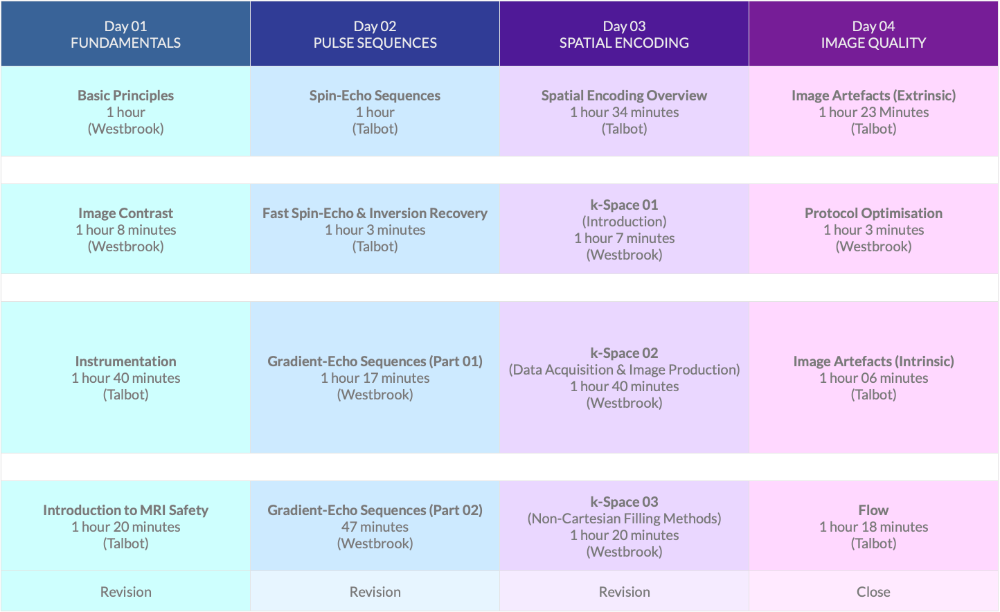
The MRI in Practice course has 16 core lectures that contextualise MRI physics to clinical practice. These are divided into 4 logical sessions covering Fundamentals, Pulse Sequences, Image Production and Image Quality. The lectures themselves only take about 5 hours to complete in each session, but when combined with the other related activities we recommend that you put aside one study-day for each session as a minimum. The additional activities include revision sessions and our MRI simulator which directly links the theory of each lecture to the relevant clinical practice. Each course has an event duration of 9 days, and the participants can choose to pace their learning accordingly. The examples shown below are purely illustrative - to show some common configurations that may help when study leave is tight, or when someone wishes to have a break between the fundamentals and the more advanced topics. Ultimately the choice can be made by the participant, the content can be accessed at any time over the 9 days, and our only firm requirement is that the 16 core lectures must be completed by the end of day 9. We strongly advise participants to put aside four study days as a minimum and certainly no fewer than three.
PLUS FREE HANDBOOK COURSE
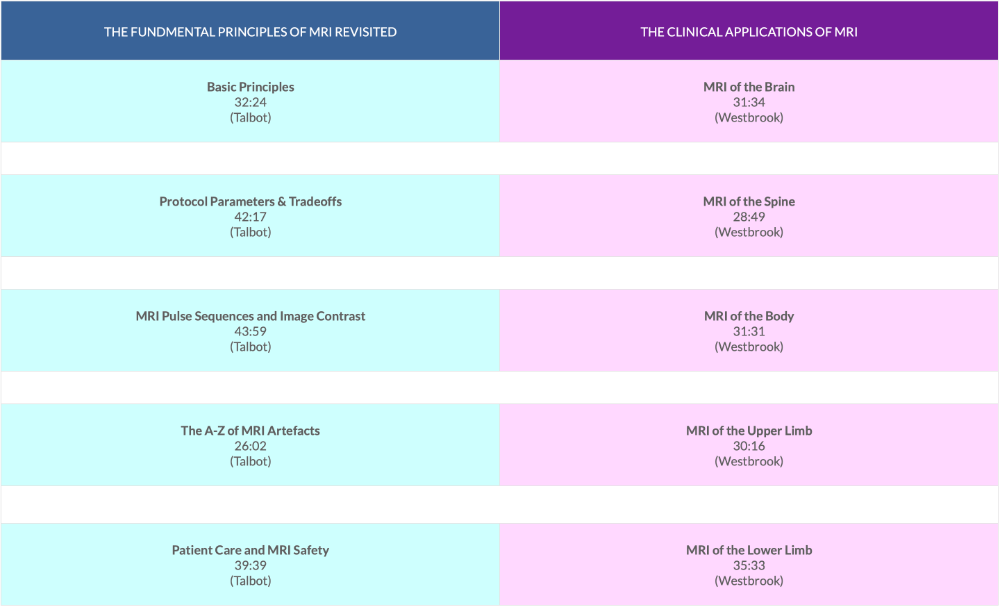
In addition to the 15 lectures shown above, all participants who successfully complete the MRI in Practice Online will also be given access to our new Handbook of MRI Technique course completely free of charge!
This is an amazing deal that no other course provider can match. The Handbook course is based on our book of the same name and covers clinical indications, patient care, patient preparation and screening, MRI technique (patient positioning, slice prescription and pulse sequences) anatomy and pathology - for all major body areas PLUS 5 concise technical lectures that revisit and reinforce the concepts covered on the MRI in Practice course - making it perfect for revision. Other providers teach this material using OUR BOOK - cut out the middle-man. Don't pay for a physics course and a clinical technique course when we offer you both for the price of one!
Best of all, the Handbook course is available on demand and the lectures can be accessed wherever and whenever the participants wish to take part.
Handbook of MRI Technique
Introducing Jeremy - your 24/7 MRI Mentor!
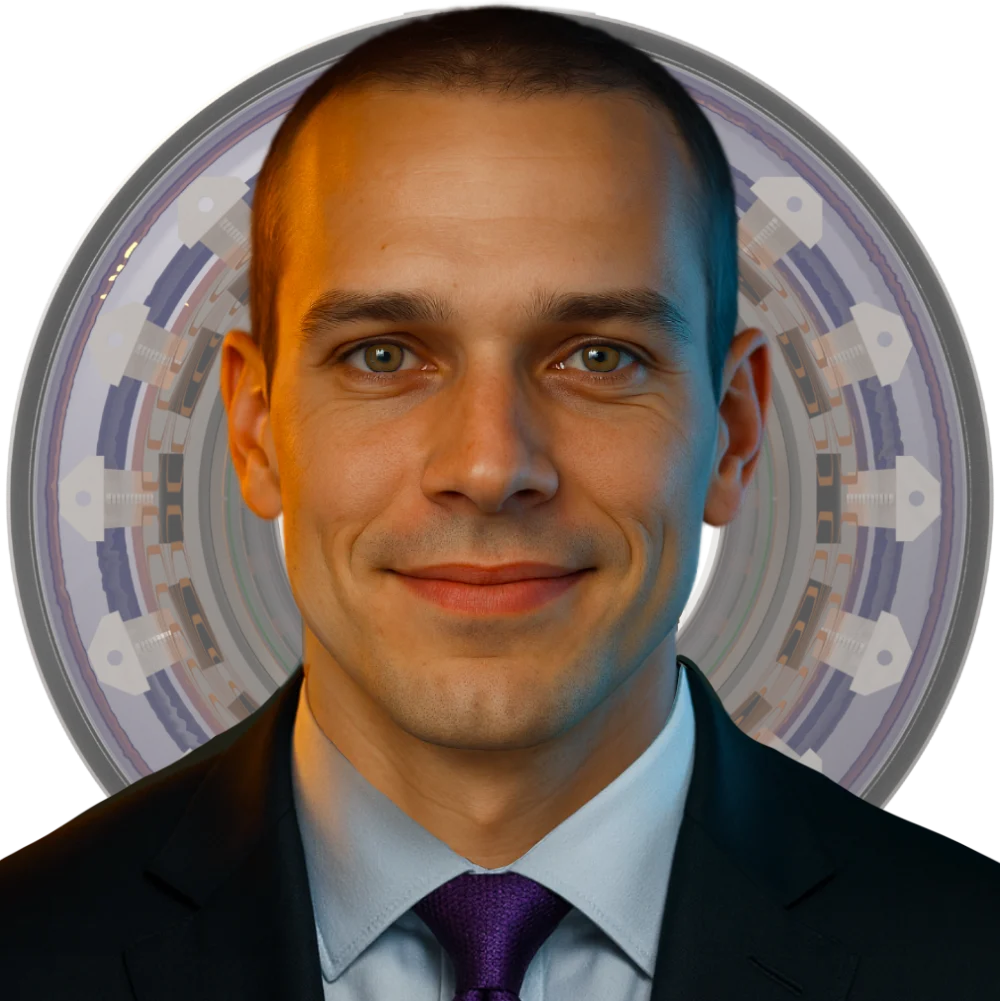
On demand courses require on-demand Q&A. Cathy and John are usually on hand to answer your questions over the duration of the course, but when we have participants across 12 time-zones or more, there may be brief periods when we are not available. Introducing Jeremy - our new recruit!
Imagine watching a lecture with a friend who is a real expert on MRI. Whenever you needed a little more explanation you could pause the presentation and ask your genius friend to expand on the topics covered. This is exactly the role Jeremy plays.
Having been on our book cover for many years, Jeremy is probably one of the best known faces in MRI - now he is here to help take your questions. Jeremy is a generative pre-trained transformer - but he is not chat GPT. Jeremy is our very own AI chat host, trained in house, hosted only on our course platform and definitely not connected to dodgy internet sites!
Jeremy's training materials, written by ourselves, run well over 150,000 words - more than a doctoral thesis. Compiling the answers to anticipated questions took over 3 months of writing, so when you ask Jeremy a question, it is our answer he gives you, but in the twinkle of an eye.
Lecture Content
Lecture Content
Streaming Video
1. It provides better quality viewing experience.
As academics, we are very well-versed in distance learning. We delivered a Master of Science course in MRI for 15 years entirely on-line so we know what works well, and what doesn't work at all. Webinar software such as Microsoft Teams, Zoom, BigBlueButton or Adobe connect, are capable of presenting very basic PowerPoint presentations, PDF files or live screen-sharing of other types of presentation, however, the screen refresh rate can be very poor. This is not an issue when a presentation just has bullet points and a few images, but is entirely unsuited to our dynamic content. Animations tend to jitter and lag. Our lectures contain hours of CGI animations running at 30fps and in high-definition. HD video is the only way we can guarantee a high quality experience that even exceeds live conference data projection.
2. It mitigates internet connection issues.
Since putting the course online in 2021, we have discovered that about 5% of our participants have local issues with connection. This is not a fault of the course, but the same issues that might occasionally cause you to lose broadband connection when browsing the web. In a business meeting you might miss a few minutes and it makes no difference, you don't even realise what you missed. With lectures, however, this could be a problem, you might miss something really crucial to your understanding of everything that follows - and you would not even be aware. Streaming video fixes this problem at a stroke. If you lose connection you can take over exactly where you left off and you don't miss a single thing.
Even worse, if the lecture presenter should lose connection the entire course would grind to a halt. Over the last four years, there have been at least two occasions when our local internet service has failed during a course. On one occasion there was a service outage for 30 minutes
To prevent this from affecting the course, we have enlisted a well-known streaming provider to host the content. By keeping everything on the cloud, it doesn't matter if our connection fails, the entire course will still be accessible to everyone. We use industry-standard technology from Amazon Web Servers - these are the servers that run Amazon Prime Video and our streaming format is the same as Netflix and most of the major Hollywood studios. We have to pay the hosting company for every second of video watched by every participant, but we thought that this was worth the cost. We needed something robust, secure and capable of high-quality streaming to a large number of people simultaneously and without eating too much of your bandwidth. We think we have succeeded in our goal and there is a sample video below that will allow you to test out your own setup.
3. It allows Rewinding and rewatching.
This is something that makes our online lectures better than live conference lectures. If you don't understand something when you hear it, you can rewind and watch it again. At the end of each presentation you can go back and review sections of the presentation that you would like to revisit. Our participant feedback tells us that they love this feature and it can only be achieved using streaming video.
Click the tabs below to learn more about each lecture.
Artefacts (Talbot) 83 minutes
Aim: to facilitate the understanding of the appearances and cause of common artefacts and their remedies. May include:
- Aliasing
- Nyquist ghost
- Magnetic susceptibility artefact
- RF Anomalies
…and more.
Artefacts (Talbot) 66 minutes
Aim: to facilitate the understanding of the appearances and cause of common artefacts and their remedies. May include:
- Out-of-phase signal loss
- Chemical shift
- Phase mismapping
- Magic Angle
…and more.
Basic Principles (Westbrook) 57 minutes
Aim: to investigate the fundamental principles of MRI including:
- Nuclear structure
- MR active nuclei
- Alignment
- Precession and resonance
- Signal generation
- Relaxation processes
Flow and MRA (Talbot) 80 minutes
Aim: to provide an overview and basic understanding of the appearances of flow including:
- Time of flight, entry slice phenomenon, and flow anomalies
- Post processing and the maximum intensity projection algorithm
- Inflow, Phase Contrast, Black-Blood, BOLD and Fresh Blood Imaging,
- Mechanism of flow-dependent MRA sequences
- Advantages & disadvantages in clinical use
For the three-day version of the course this content is included in the artefacts sessions.
Gradient Echo Sequences (Westbrook) 183 minutes
Aim: to investigate the advanced mechanisms of gradient echo imaging and their clinical uses including:
- Principles of Gradient Echo Pulse Sequences
- Weighting in Gradient Echo Pulse SequencesThe steady state (advanced concepts)
- Coherent gradient echo
- Balanced Gradient Echo
- Incoherent gradient echo
- Steady state free precession
- Fast gradient echo
- Echo planar imaging
- Diffusion Weighting
Image Contrast (Westbrook) 68 minutes
Aim: to evaluate the various mechanisms responsible for image contrast in MRI including:
- Molecular make-up of fat and water
- T1 recovery
- T2 decay
- Diffusion Weighting
- Image weighting characteristics
- Introduction to pulse sequences
Instrumentation (Talbot) 100 minutes
Aim: to investigate types of equipment used in MRI and their safe use including:
- Magnets: principles of, construction, homogeneity.
- Shielding
- Shimming
- Gradients
- Radio Frequency: shielding, transmit/receive coils
k-space and Data Acquisition (Westbrook)
1.5 hours (x2)
Aim: to explore in-depth the principles that underpin data acquisition in MRI including:
- k-space functions and characteristics
- Data sampling techniques
- k-space traversal
- k-space filling in basic and advanced sequencing
- k-space filling modifications including parallel imaging
Protocol Optimisation (Westbrook) 63 minutes
Aim: to facilitate the understanding of the factors that affect image quality; their mechanisms and trade-offs including:
- Signal to noise ratio (SNR)
- Contrast to noise ratio (CNR)
- Spatial resolution
- Scan time
- Decision making strategies
Revision (Talbot) 60 minutes
Aim: to consolidate the basic knowledge gained through self-marked timed evaluation:
- Basic Principles
- Contrast Mechanisms
- Instrumentation
- Basic Pulse sequences
- Image Optimisation
Please note, the on-line course offers revision activities after each session or at the end of each day.
Safety (Talbot) 78 minutes
Aim: to review all MRI safety issues including:
- Static-field - spatial gradient dangers
- Time varying gradient-field – nerve stimulation
- Secondary (RF) field dangers - heating & antenna effect
- Cryogens – quenches and anoxia
- Contraindications for MRI
with real-life examples of safety incidents from around the world.
Spatial Encoding (Talbot) 94 minutes
Aim: to facilitate the understanding of gradient functions for the purpose of spatial encoding including:
- An introduction to data sampling
- Slice selection
- Frequency encoding
- Phase encoding
- Fourier Transformation
Spin Echo Pulse Sequences (Talbot) 60 minutes
Aim: to investigate the basic mechanisms of spin echo imaging including:
- T2* effects
- RF rephasing
- Single and dual echo spin echo
Fast Spin Echo Pulse Sequences (Talbot) 68 minutes
Aim: to investigate the basic mechanisms of fast spin echo imaging and Inversion recovery sequences including:
- Fast Spin Echo, advantages and trade-offs
- Driven Equilibrium
- Inversion recovery
Our Presentations - Widescreen HD
Our Presentations - Widescreen HD
MRI in Practice Slide
vs.
Genuine slide from a competitor course
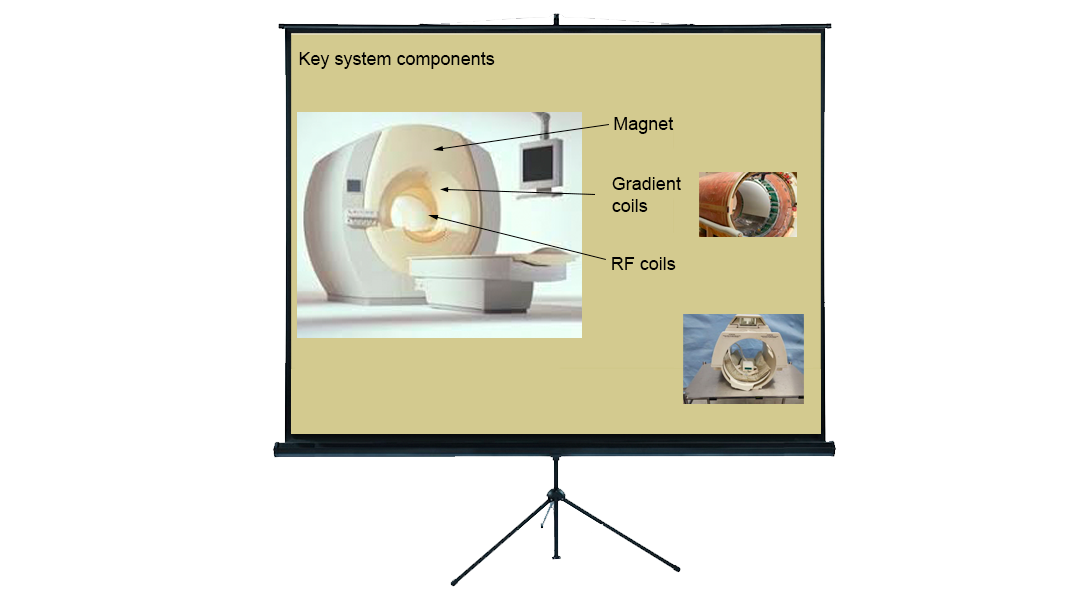
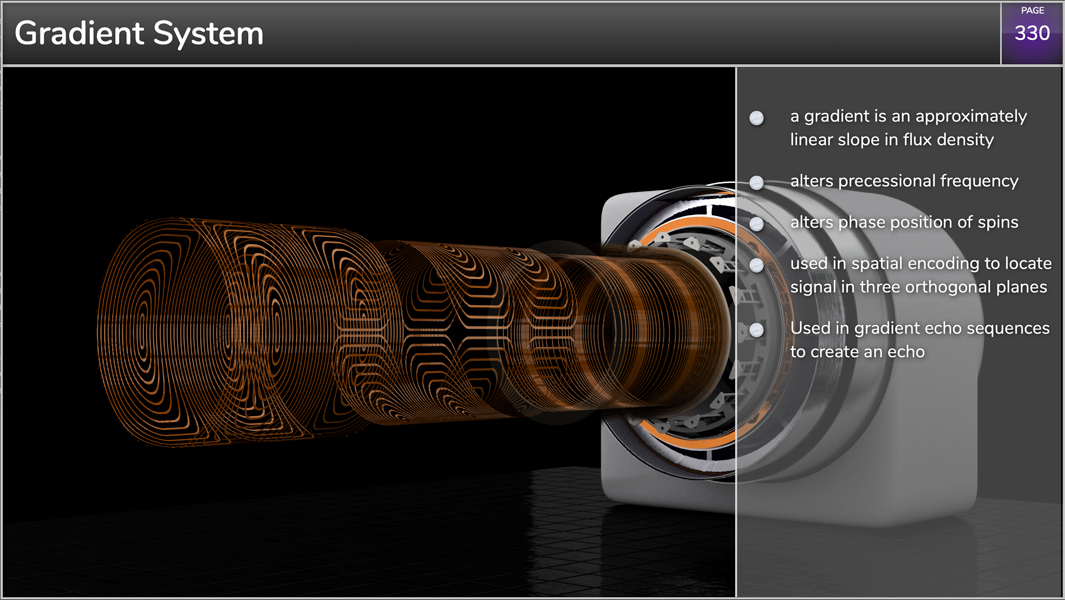
As professional educators we understand that the success of a course hinges not only on the expertise and presentation skills of the lecturers, but also on the quality of the learning materials. All of our presentations are put together using state of the art widescreen presentation software with bespoke HD images and video. The above comparison will give you some idea of the difference that makes to a presentation. On the left is a slide from our MRI Instrumentation lecture, on the right is a slide from another commercial MRI course. Slide the handle to compare.
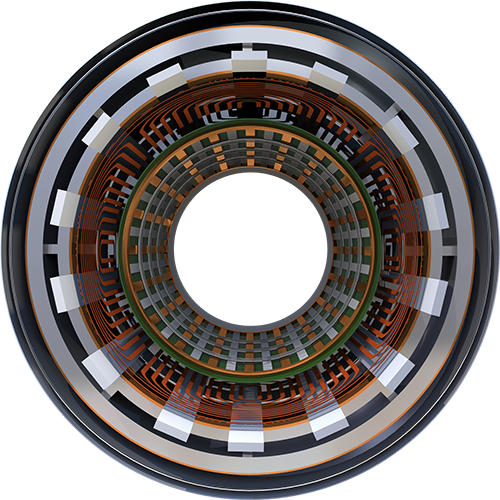
In terms of content, if you are paying for a high-quality learning experience, we think you deserve better than inaccurately labelled images and recycled web content. For this reason, we have spent the last 10 years creating computer-generated imagery (over 700 individual models in total) that show all of the fundamental principles of MRI - including a fully-equipped virtual MRI scanner. These models have been rendered into high-definition video to create our ground-breaking graphics and animations. When we show you the magnet solenoids, the gradient coil or the RF transmit coil you not only get to see what these components actually look like, but we can dismantle the scanner right in front of your eyes to show exactly how these components relate to each other physically and functionally. Because our course is constructively aligned with our book (not just named after it) the slides also present the relevant page numbers as a revision aid for delegates. Our HD graphics bring MRI concepts alive in a way that no other MRI course can match.
MRI Simulation
MRI Simulation
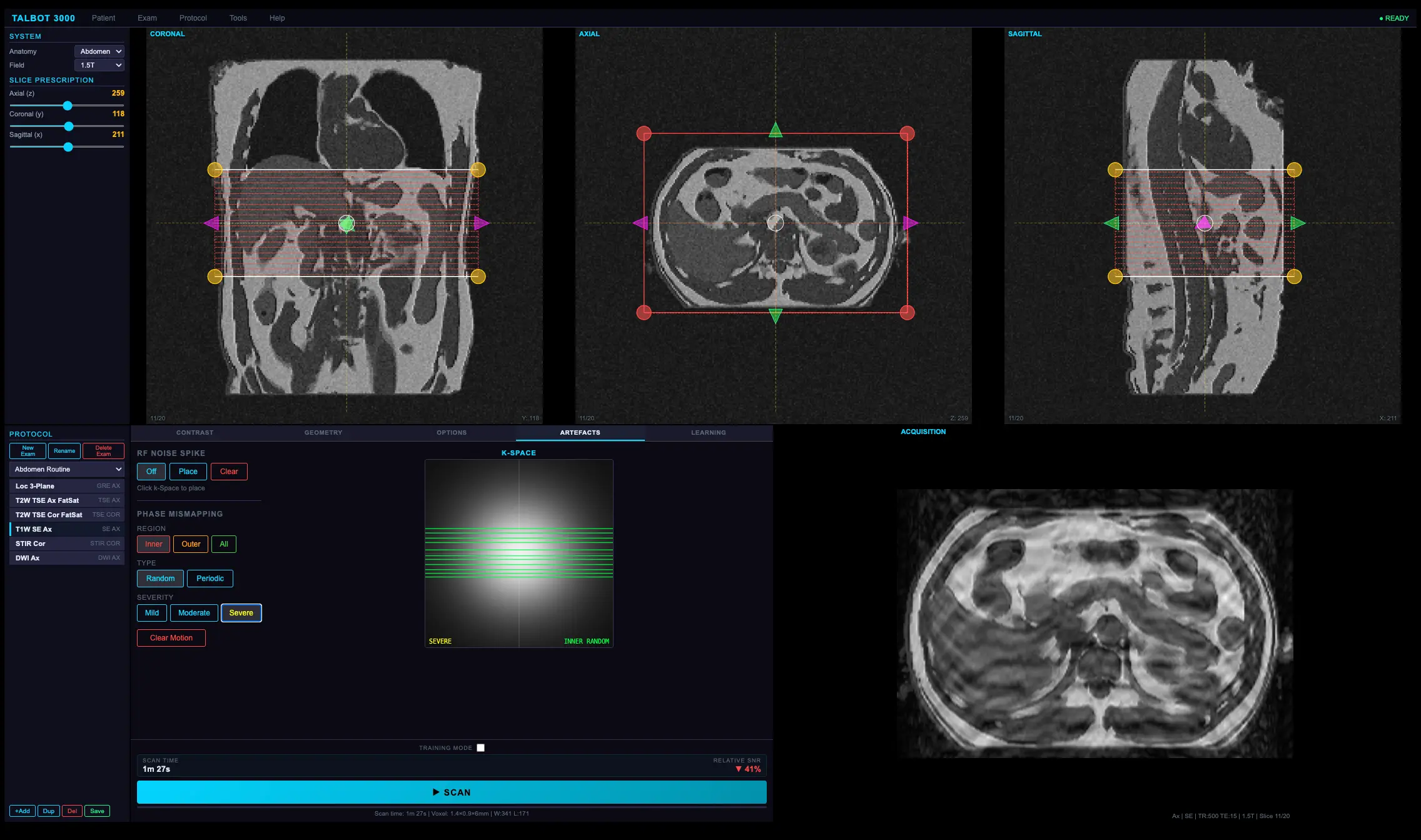
Brand new for 2026 - 12 months FREE ACCESS to our amazing MRI Simulator.
All of our lectures have used a simulated MRI scanner for the last 25 years. A photorealistic model and k-space simulator that we use when teaching Instrumentation and all the topics that ever relate physics to practice. To date the simulators were only used to create lecture materials - now participants can interact with the simulator just like a real scanner!
Magnetic resonance imaging is one of the most powerful diagnostic tools in modern medicine, yet the physics governing image contrast and image optimisation remains one of the most challenging topics for new practitioners to master. Understanding how pulse sequence parameters interact to produce clinically useful images requires more than textbook knowledge — it demands hands-on experience with the cause-and-effect relationships between acquisition settings and the resulting image.
Our new Virtual MRI Console addresses this educational challenge directly.
Developed by John Talbot, a learning specialist qualified to doctoral level in technology-enhanced learning, this is a browser-based simulator that places a functional MRI console in the hands of every student. No scanner access required. No patient risk. No booking conflicts. Just immediate, interactive, consequence-free exploration of MRI physics and image optimisation.
This simulator is dedicated to learning about image contrast and image optimisation and has been designed and built from the ground up so it meshes perfectly with our lectures. We include over 50 learning activities to perform using the simulator that relate directly to the lectures. Every topic we cover on the course relating to image contrast, artefacts and image optimisation can now be accurately explored using the simulator - remember, our name is MRI in PRACTICE and this simulator keeps us right at the forefront of that underpinning principle. No other course can match our perfect synchronicity between underpinning physics, our lectures, our book and your clinical outcomes.
The Educational Challenge
Newly qualified radiographers and trainee radiologists face a steep learning curve when they begin clinical MRI practice. The relationships between TR, TE, TI, flip angle, bandwidth, matrix size, field of view, and the resulting image contrast are complex, interdependent, and often counter-intuitive. Traditional teaching methods — lectures, textbooks, observation — can describe these relationships, but they cannot replicate the experience of sitting at a console and watching an image change in real time as each parameter is adjusted.
Scanner time is expensive, clinically allocated, and rarely available for teaching purposes. Even when training slots can be arranged, the learning opportunity is limited by the need to work with real patients and the pressure to produce clinically acceptable images. There is no opportunity to set deliberately poor parameters, observe the result, and understand why it failed.
Our simulator removes these barriers entirely.
Physics-Driven Simulation
Unlike simplified teaching aids that display pre-rendered images or use look-up tables, our simulator calculates every pixel of every image from first principles using the Bloch equations. Signal intensity for each tissue type is computed in real time based on its T1, T2, and proton density values at the selected field strength, using the exact signal equations for the chosen pulse sequence. The result is a realistic synthetic MR image that responds to parameter changes with the same physics that governs a real scanner.
This approach means there are no artificial limits on what the student can explore. Every combination of parameters produces a physically meaningful result, even if that result is a poor image. A student who sets TR too short for T2 weighting will see the T1 contrast leak into their image. A student who selects an inappropriately high echo train length will see phase-direction blurring develop. A student who reduces bandwidth too aggressively will observe chemical shift artefact grow at fat–water interfaces. Every mistake becomes a teaching moment.
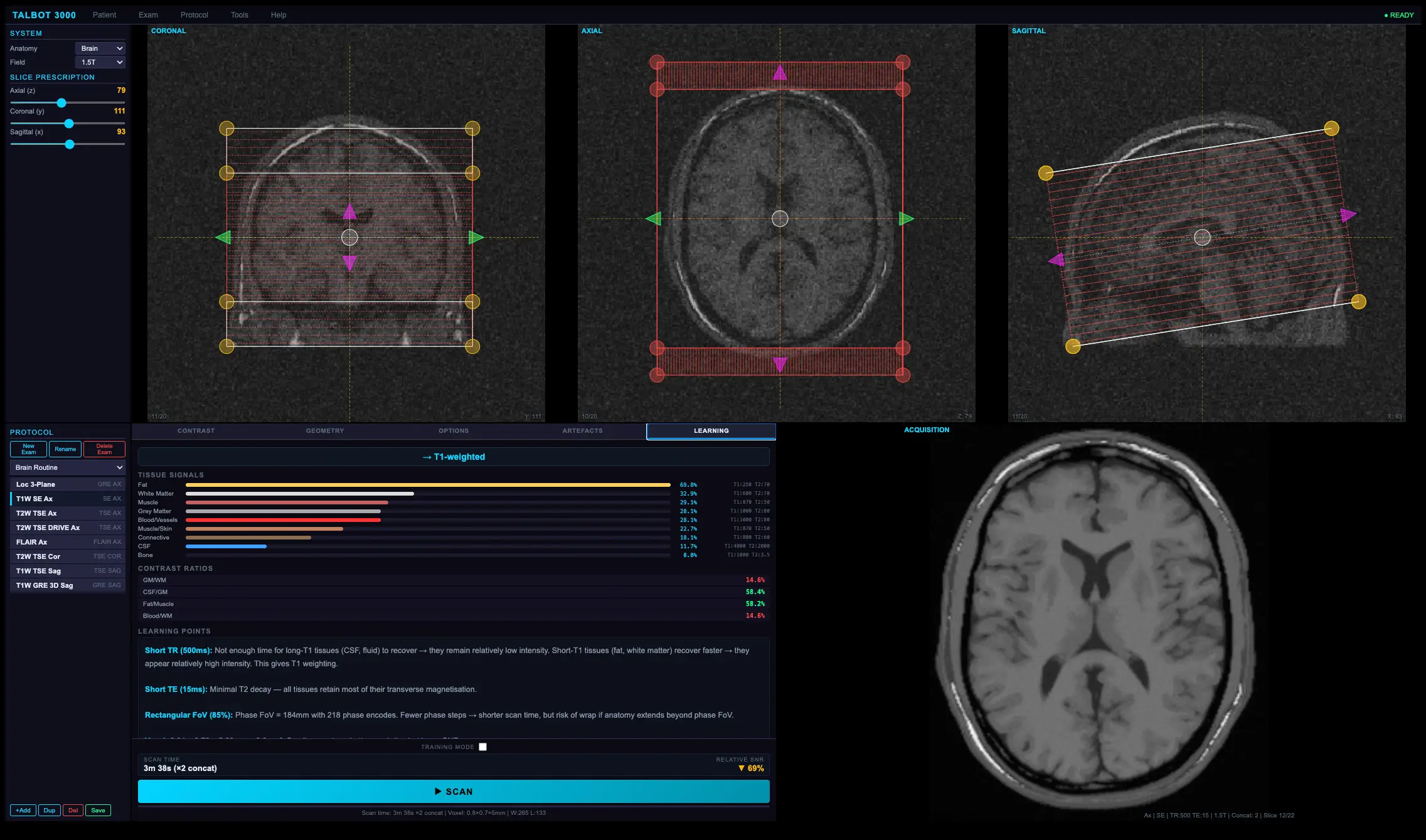
Capabilities
Pulse Sequence Library
The simulator provides a comprehensive library of pulse sequence implementations, each with correct signal equations, clinically appropriate parameter ranges, and generic protocol naming:
- Spin Echo (SE) — the foundational sequence for understanding T1, T2, and proton density weighting through TR and TE manipulation.
- Turbo Spin Echo (TSE) — with echo train length control, phase-direction blurring simulation, and magnetisation transfer contrast effects that realistically reduce grey–white matter differentiation at high ETL. ETL auto-sets to appropriate values based on matrix size.
- Gradient Echo (GRE) — implemented as three distinct sub-types: Spoiled (SPGR/FLASH/T1-FFE), Rewound (GRASS/FISP/FFE), and Balanced SSFP (TrueFISP/FIESTA/b-FFE), each with its own steady-state signal equation and characteristic contrast behaviour. Flip angle control demonstrates the Ernst angle relationship and its effect on T1 contrast.
- Inversion Recovery (IR) — with adjustable TI for selective tissue nulling. Presets automatically calculate field-strength-appropriate null points for white matter and grey matter.
- STIR — with field-strength-adaptive fat nulling and educational warnings about contraindication with gadolinium contrast.
- FLAIR — with field-strength-adaptive CSF nulling for periventricular lesion conspicuity.
- Single-Shot TSE (SS-TSE) — also known as HASTE (Siemens), SS-FSE (GE), or SSH-TSE (Philips). Fills the entire k-space in a single TR using very long echo trains, demonstrating the trade-off between acquisition speed and T2 blurring. ETL automatically matches the phase matrix size.
- Spin Echo EPI (SE-EPI) — single-shot echo planar imaging with spin echo preparation, demonstrating the extreme speed and characteristic geometric distortion, susceptibility artefacts, and chemical shift effects of EPI readouts.
- Gradient Echo EPI (GRE-EPI) — single-shot EPI with gradient echo preparation and T2* weighting, showing the increased susceptibility sensitivity compared to the spin echo variant.
- Diffusion Weighted Imaging (DWI) — based on the Stejskal-Tanner pulsed gradient scheme with adjustable b-value. Demonstrates how increasing diffusion sensitisation suppresses signal from freely mobile water while retaining signal from restricted diffusion environments. Generates b=0 reference images alongside diffusion-weighted images for comparison.
- Dixon (Two-Point) — acquires in-phase and opposed-phase echoes to generate separate water-only and fat-only images, plus the conventional in-phase and opposed-phase contrast. Demonstrates the chemical shift-based fat-water separation principle and the India ink artefact at fat-water boundaries.
- Driven Equilibrium (DRIVE) — available as a toggle on TSE, STIR, and FLAIR sequences. Also known as RESTORE (Siemens) or FR-FSE (GE). At the end of each echo train, a −90° tip-up pulse restores remaining transverse magnetisation back to the longitudinal axis. This dramatically boosts signal recovery for long-T2 tissues such as CSF and fluid, enabling T2-weighted imaging with significantly shorter TR and reduced scan time. Short-T2 tissues are barely affected. Students can directly compare standard T2W TSE at TR 4000 ms with a DRIVE-enhanced version at TR 2000 ms and observe that CSF brightness is maintained while scan time is halved. [NEW]
- 3D Volumetric Acquisition — available as a 2D/3D toggle on SE, TSE, GRE, IR, STIR, and FLAIR sequences. Switches from conventional 2D multi-slice excitation to slab-selective 3D acquisition with phase encoding in both the in-plane and partition (slice) directions. Produces contiguous, gap-free partitions through the slab with no cross-talk artefact, an SNR boost proportional to the square root of the number of partitions, and the ability to achieve sub-millimetre isotropic or near-isotropic voxels suitable for multiplanar reformatting. Demonstrates the scan time cost of the additional partition-encoding dimension and the occurrence of slab wrap-around aliasing when anatomy extends beyond the excited slab. Built-in protocols include 3D T1W GRE (SPGR/VIBE/LAVA/BRAVO style) and 3D FLAIR examples for both brain and abdomen. [NEW]
Comprehensive Parameter Control
Comprehensive Parameter Control
Every clinically relevant acquisition parameter is independently adjustable, giving students full control over the signal-to-noise, spatial resolution, and scan time trade-offs that define real-world protocol optimisation:
- Timing parameters: TR (2–10,000 ms), TE (1–300 ms), TI (10–5,000 ms), flip angle (1–90°), echo train length (2–32).
- Spatial parameters: FOV (100–500 mm), rectangular FOV (50–100%), phase encoding direction, frequency matrix (64–512), phase matrix (64–512), slice thickness (1–10 mm).
- Signal quality: NEX (1–4), parallel imaging acceleration (R = 1–4) with g-factor noise penalty, receiver bandwidth (50–500 Hz/pixel).
- Clinical options: frequency-selective fat saturation, intravenous gadolinium contrast simulation with flow void modelling, no phase wrap oversampling, Driven Equilibrium (DRIVE/RESTORE) for TSE variants, and 2D multi-slice or 3D volumetric acquisition mode with adjustable slab thickness and partition count.
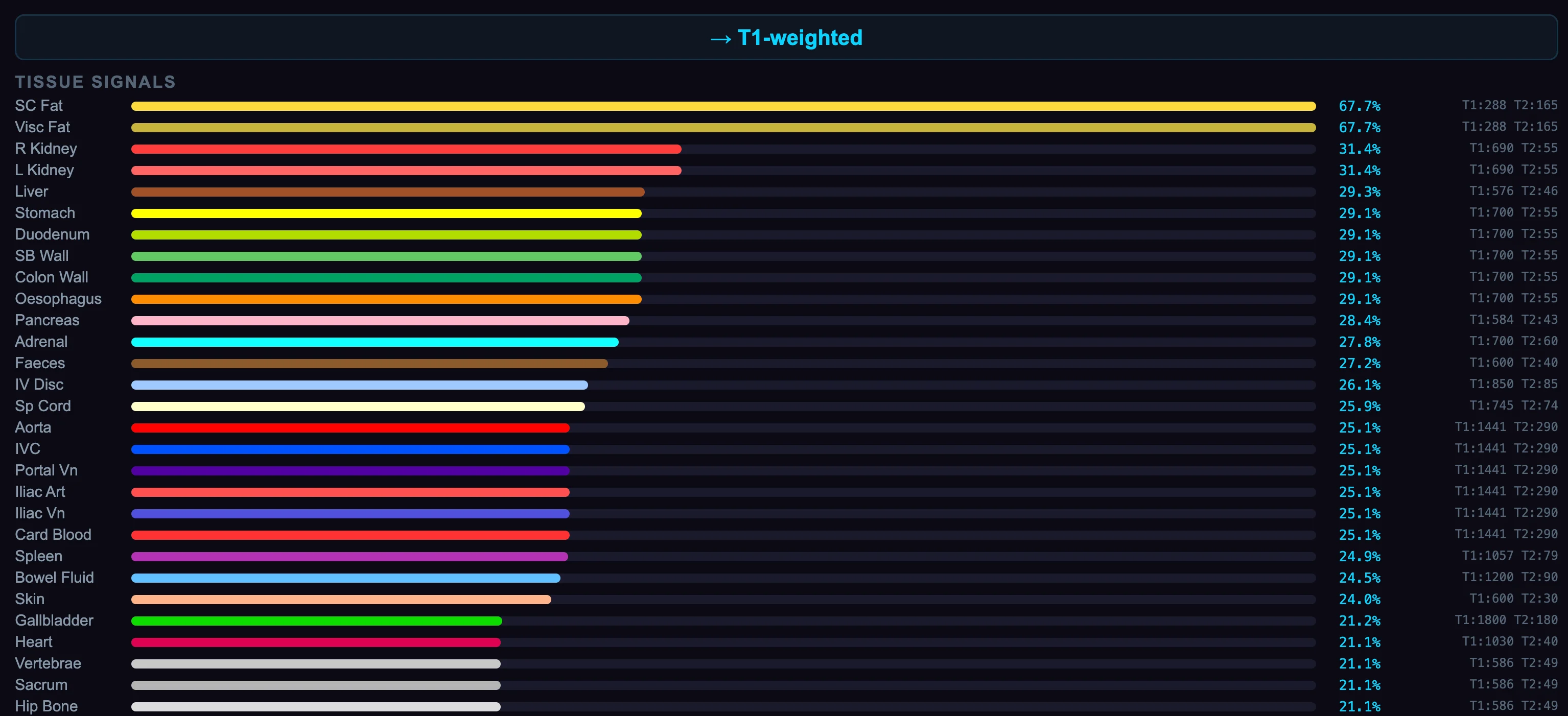
Tissue signal calculations for every slice
Multi-Anatomy, Multi-Field-Strength Design
The simulator includes accurately segmented tissue maps for two anatomical regions — axial brain (eight tissue types including cortical bone, CSF, grey matter, white matter, fat, muscle, skin, and blood) and abdomen (all tissue types). Each anatomy can be imaged at 0.5T, 1.5T, or 3.0T, with a complete tissue relaxation database providing field-strength-dependent T1, T2, and proton density values derived from the published topic literature.
More anatomical areas are scheduled to be added shortly - and all upgrades will be accessible to our participants over the duration of their access period.
Artefact Simulation
Understanding artefacts is essential for clinical practice, yet difficult to teach without hands-on experience. Our simulator reproduces all of the major acquisition-related artefacts encountered in routine imaging, each with physically correct behaviour that responds to parameter changes exactly as it would on a real scanner:
- Phase wrap-around — visible when the phase FOV is smaller than the anatomy, with correct wrap direction that follows the user's chosen phase-encoding axis. Removable with the no-phase-wrap oversampling toggle, which doubles acquisition in the phase direction at the cost of scan time.
- 3D slab wrap-around — in 3D volumetric mode, the partition direction is phase-encoded rather than slice-selected. Anatomy extending beyond the excited slab wraps into the volume from the opposite end, appearing superimposed on the edge partitions. This is the 3D equivalent of in-plane phase wrap and emerges naturally from the partition-encoding physics. The Learning panel detects when tissue is present outside the slab and provides specific guidance on solutions including increasing slab coverage or applying spatial saturation bands. [NEW]
- Chemical shift (Type 1) — bandwidth-dependent spatial misregistration at fat–water interfaces, correctly scaled to field strength and displayed in the frequency-encoding direction. Students can directly observe how increasing receiver bandwidth reduces the displacement at the expense of signal-to-noise ratio.
- Chemical shift (Type 2 / out-of-phase signal loss) — signal cancellation at fat–water boundaries on opposed-phase gradient echo images, visible in the Dixon opposed-phase reconstruction and at specific echo times on GRE sequences.
- TSE blurring — T2-dependent signal decay across the echo train causing high-spatial-frequency attenuation in the phase-encoding direction. Becomes progressively more pronounced as echo train length increases, particularly visible on tissues with short T2.
- Truncation (Gibbs ringing) — oscillatory signal ringing at high-contrast interfaces caused by truncation of k-space at low matrix sizes. Correctly manifests as alternating bright and dark bands parallel to sharp tissue boundaries and diminishes as matrix resolution increases.
- Cross-talk — signal loss from incomplete magnetisation recovery between adjacent 2D slices. Worsens with small or negative slice gaps and short TR values, and is mitigated by automatic concatenation when the number of slices exceeds the TR capacity. The simulator correctly models interleaved slice ordering across concatenations and the resulting reduction in cross-talk. Eliminated entirely in 3D acquisition mode, where the slab is uniformly excited with no imperfect slice profiles. [NEW]
- Motion artefact — periodic ghosting propagated in the phase-encoding direction from simulated patient motion during acquisition. Demonstrates why motion ghosts appear along the phase axis regardless of the actual direction of movement.
- RF noise spike (zipper artefact) — simulates the effect of a corrupted data point in k-space from external RF interference, producing a characteristic striped zipper pattern across the image. Students can visualise the corresponding spike in the k-space display.
- Phase mismapping — k-space visualisation showing how data collected at different echo times during a TSE echo train maps to different phase-encoding lines, with an interactive graphic illustrating the relationship between echo position, k-space location, and resulting image contrast.
- EPI geometric distortion — susceptibility-induced spatial distortion characteristic of echo planar imaging sequences, demonstrating why EPI images show warping in the phase-encoding direction near air–tissue interfaces.
- Realistic noise modelling — signal-dependent Gaussian noise that responds correctly to voxel volume, number of signal averages (NEX/NSA), receiver bandwidth, field strength, parallel imaging acceleration factor, and 3D partition count. In 3D acquisition mode, the SNR boost from partition encoding (proportional to √partitions) is correctly applied, allowing students to directly compare noise levels between equivalent 2D and 3D acquisitions.
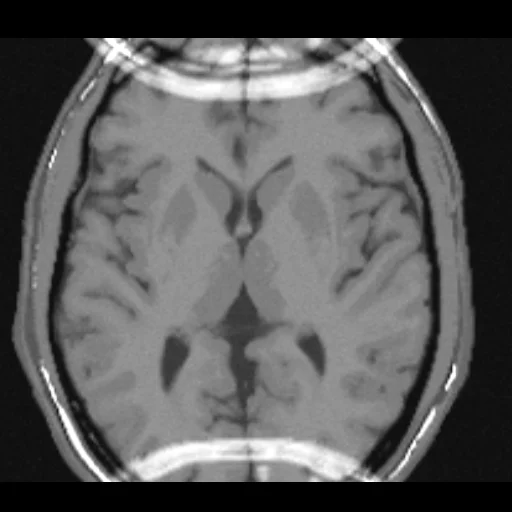
Aliasing
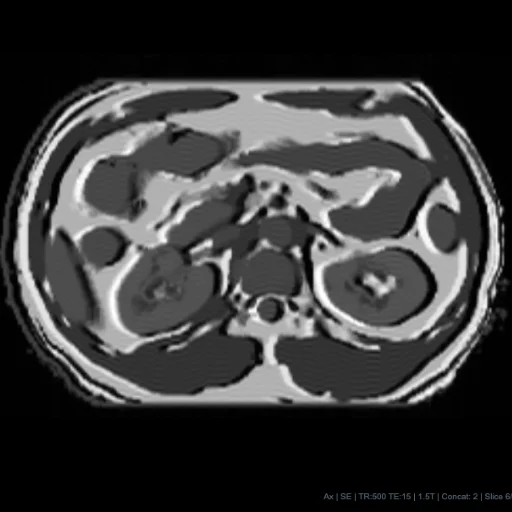
Chemical Shift
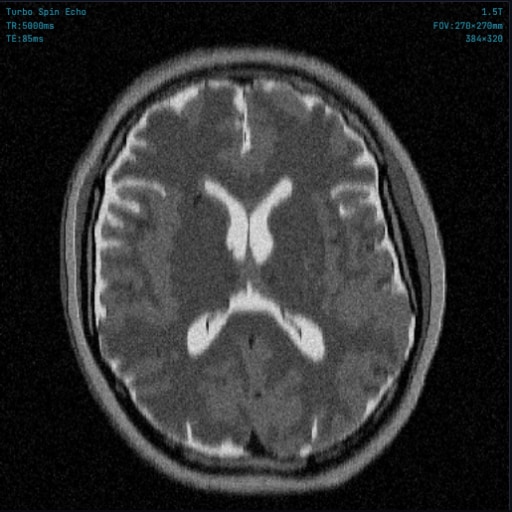
Echo Train Blur
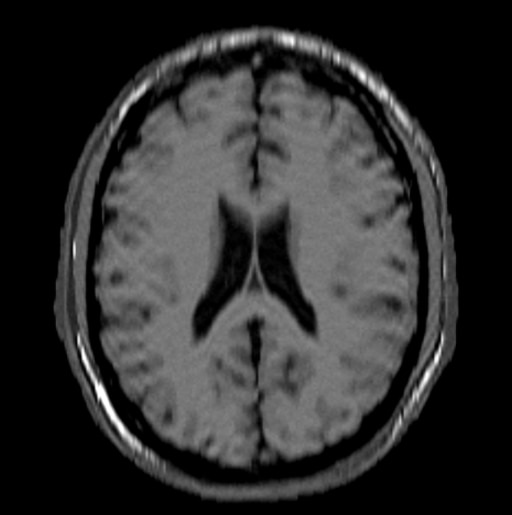
Truncation
Our course covers 26 different artefacts - it's better that our new course participants can learn about these disasters on the simulator rather than on real patients during a busy list!
Protocol Optimisation Engine
The Optimise engine embedded within the simulator encapsulates the protocol design expertise that typically takes years of clinical experience to develop. For any given combination of pulse sequence, image weighting, anatomy, and field strength, the engine calculates a complete optimised protocol that balances diagnostic image quality against acquisition time — the fundamental trade-off at the heart of every MRI examination.
The optimisation considers the full parameter space: timing parameters for contrast, spatial parameters for resolution and coverage, receiver bandwidth for SNR and chemical shift control, parallel imaging for scan time reduction with appropriate g-factor trade-off, signal averaging for thin-slice SNR compensation, phase encoding direction for anatomy-appropriate wrap avoidance, and fat saturation where clinically indicated.
When the student engages with the built-in Learning Mode function, they can build a sequence/protocol from scratch - test the image appearance with every change and when they are done, the feedback report provides specific, educational commentary on every parameter that differs from the optimised protocol. This commentary explains not just what should change, but why — linking each adjustment to its physical consequence in terms of contrast, resolution, SNR, artefact behaviour, or scan time. Estimated scan times are displayed for both protocols, quantifying the time penalty of suboptimal parameter choices.
Technical Specification
Our simulator was designed an built in-house by Dr John Talbot, whose doctoral thesis was in the field of technology enhanced learning. It is delivered as a browser-based application requiring no software installation, plug-ins, or dedicated hardware. It runs in any modern web browser on desktop, laptop, or tablet devices. Image rendering is performed client-side in real time, providing instantaneous visual feedback as parameters are adjusted. The tissue maps, relaxation database, and edge detail overlays are served from a secure, authenticated server environment integrated with the MRI in Practice online learning platform.
Physics fans only…
SIGNAL MODEL
The Talbot 3000 computes signal intensity per voxel from the Bloch equations using tissue-specific T₁, T₂, and ρ values drawn from a field-strength-indexed relaxation database (0.5 T, 1.5 T, 3.0 T) compiled from Stanisz et al. (2005), de Bazelaire et al. (2004), and Gold et al. (2004). The full pulse sequence library is implemented with closed-form steady-state signal equations: SE (ρ(1−e⁻ᵀᴿ/ᵀ¹)e⁻ᵀᴱ/ᵀ²), TSE with effective-TE echo-train modulation and MT attenuation coefficients, three GRE sub-types (spoiled: Ernst-angle steady-state; rewound: √(T₂/T₁)-dependent SSFP−FID; balanced: T₂/T₁-weighted bSSFP with near-unity ρ weighting), IR, STIR, and FLAIR with full longitudinal recovery/inversion terms, single-shot TSE, SE-EPI, GRE-EPI, DWI with per-tissue ADC-based diffusion attenuation, and two-point Dixon with in-phase/opposed-phase fat–water separation.
Driven Equilibrium (DRIVE) modifies the TSE, STIR, and FLAIR signal equations to account for the −90° tip-up pulse at the end of each echo train. The remaining transverse magnetisation after the echo train, M_xy = ρ·exp(−ETL·ESP/T₂), is restored to Mz by the DRIVE pulse. The starting longitudinal magnetisation for the next TR becomes Mz = ρ·[1 − exp(−TR/T₁)·(1 − exp(−ETL·ESP/T₂))], replacing the standard ρ·(1 − exp(−TR/T₁)). For tissues with long T₂ (CSF, T₂ ≈ 2000 ms), the correction term approaches zero and Mz approaches ρ regardless of TR — explaining why DRIVE enables T2-weighted imaging with dramatically shorter TR. For short-T₂ tissues, the correction is negligible and the signal is unchanged. [NEW]
3D volumetric acquisition replaces slice-selective excitation with slab-selective excitation and adds a second phase-encoding dimension along the partition (slice) direction. The scan time becomes TR × phase_PE × partitions × NEX / ETL / PI. The SNR benefit arises from the coherent signal contribution of all partitions, yielding an improvement factor of √(partitions) over equivalent 2D slices. [NEW]
Fat saturation applies a 90% signal attenuation factor to lipid-labelled voxels. Gadolinium contrast modifies T₁ via the relaxivity relation 1/T₁,post = 1/T₁,pre + r₁[Gd], with r₁ = 4.5 mM⁻¹s⁻¹ at 1.5 T, and models flow-void signal loss in vascular structures.
K-SPACE RECONSTRUCTION PIPELINE
Image formation follows a physically authentic reconstruction chain. A 512×512 complex signal matrix S(x,y) is generated from the tissue map and Bloch-equation signal values, with separate fat and non-fat channels to permit frequency-direction chemical shift displacement (Δx = δf_cs/BW, where δf_cs = 224 Hz × B₀/1.5). The composite image undergoes a 2D radix-2 Cooley–Tukey FFT to produce complex k-space data K(kₓ,kᵧ). All subsequent manipulations occur in the frequency domain:
Matrix truncation. K-space is zeroed outside the user-selected frequency and phase acquisition window (m_freq × m_phase lines centred at DC). The resulting Sinc-convolution in image space produces Gibbs truncation ringing at sharp signal boundaries — the artefact is not simulated; it emerges naturally from the mathematics of finite Fourier sampling.
TSE T₂ modulation. For turbo spin echo acquisitions, each phase-encode line is weighted by exp(−ΔTE(k)/T₂,eff), where ΔTE(k) is the temporal offset from the effective TE based on the line's radial distance from k-space centre and the echo spacing (≈10 ms). This applies a low-pass filter in the phase direction whose width is proportional to ETL, reproducing the characteristic high-spatial-frequency attenuation responsible for TSE blurring.
Parallel imaging. At acceleration factor R > 1, every Rᵗʰ phase-encode line is zeroed in k-space, producing the FOV/R aliased reconstruction visible when GRAPPA reconstruction is disabled. Toggling GRAPPA ON restores fully-sampled k-space with an SNR penalty of √R × g, where the geometry factor g = 1 + 0.15(R−1) models spatially-varying noise amplification from coil sensitivity inversion.
Noise injection. Complex Gaussian noise is added to k-space prior to inverse transform: n(k) ~ ℂ𝒩(0, σₖ²), where σₖ is derived from the voxel-volume SNR model σ ∝ V_vox½ × √NEX × B₀ / (√BW × √R × g). For 3D acquisitions, σₖ is further reduced by √(partitions) to model the coherent signal averaging across the partition-encoding dimension. This is physically correct: receiver noise enters in the frequency domain, producing spatially uncorrelated noise after magnitude reconstruction. [UPDATED — added 3D SNR factor]
3D slab wrap-around. In 3D volumetric mode, the partition direction is phase-encoded. Anatomy outside the excited slab is sampled at offset positions of ±N × slab_thickness along the slice-normal vector, where N ranges over wrap copies sufficient to cover the full anatomy extent. The wrapped signal is added to each partition's image data prior to k-space transformation, producing aliased anatomy at the slab edges that is indistinguishable from the primary signal — exactly as occurs on a real scanner. This artefact emerges from the partition-encoding geometry, not from any post-hoc overlay. [NEW]
Cross-talk simulation. For 2D multi-slice acquisitions, the simulator models incomplete longitudinal recovery between adjacent slices due to imperfect slice profiles. Signal attenuation increases with smaller slice gaps and shorter TR, and is mitigated by automatic concatenation which interleaves slice ordering across separate TR groups. In 3D mode, cross-talk is absent because the entire slab is uniformly excited. [NEW]
K-space spike artefacts. User-placed point impulses are inserted at (kₓ,kᵧ) with Hermitian-conjugate symmetry enforced at (−kₓ,−kᵧ) to maintain real-valued image reconstruction. Each spike produces a sinusoidal modulation pattern across the image at a spatial frequency and orientation determined by its k-space coordinates — reproducing the 'corduroy' or 'zipper' artefact caused by RF interference or electronic faults.
The manipulated k-space undergoes inverse 2D FFT followed by magnitude reconstruction |√(Re² + Im²)|. The result is downsampled to the acquisition matrix, with optional zero-fill interpolation (k-space zero-padding) for display. Window/level adjustment and a transparent anatomical edge overlay (Sobel gradient magnitude extracted from original MR data) are applied as final compositing steps.
ARTEFACT FIDELITY
Every artefact in the Talbot 3000 is a consequence of the acquisition physics, not a post-hoc visual effect. Gibbs ringing arises from k-space truncation. Phase wrap arises from sub-Nyquist spatial sampling. Chemical shift arises from the fat–water frequency offset in the readout gradient. TSE blurring arises from T₂ decay across the echo train. Parallel imaging aliasing arises from phase-encode undersampling. Cross-talk arises from incomplete longitudinal recovery between adjacent 2D slices. 3D slab wrap arises from partition-direction phase encoding of anatomy beyond the excited slab. Noise texture arises from complex Gaussian contamination in the frequency domain. The simulator does not contain a single line of code that draws, overlays, or fakes an artefact. They emerge from the actual signal processing just as they would on a real scanner.
Frequently asked Questions
Frequently asked Questions
Because the feedback shows very conclusively that participants much prefer the convenience and low pricing of the online course. Live courses cost approximately double the price of an online course when travel, food and accommodation are included.
From a content perspective we can offer far more content than the live courses. We can now provide clinical technique lectures and revision sessions that would not have fitted into our 4-day live programme. These are currently available at no extra charge. We also provide access to a fully-featured MRI simulator for 12 months at no charge - that would have been impossible on the live course.
We all know what "death by PowerPoint" can be like. There is nothing more boring than listening to someone read out lists of bullet points. We don't do that - after five years in the making, the latest version of our course utilises highly detailed computer generated models, rendered into photo-realistic HD wide-screen.
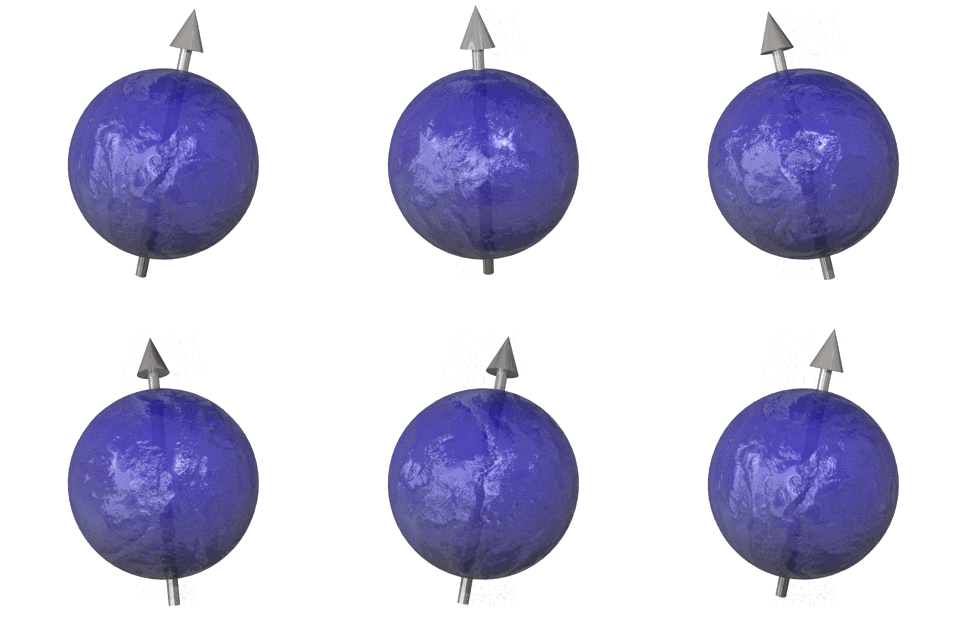
Why do we go to these lengths? Because our delegate feedback constantly reinforces the view that dynamic computer generated imagery brings difficult concepts to life in a way that nothing else can. MRI is all about motion - flipping vectors, tumbling molecules, spinning nuclei, our lectures can show this all happening right in front of your eyes, and it makes a massive difference to learning.
At the time of writing, participants (over the last 12 months) have awarded an average excellence rating of 99/100 for our lecture graphics.
The course is hypothetically accessible to every country apart from China and Russia.
That said, the cost of the course may be prohibitive to participants in countries where the exchange rate is unfavourable against the pound. That is unfortunately not within our control and we cannot make exceptions or offer discounts when the course is available to everyone else at an appropriate price-point.
This is to prevent universities, hospitals or commercial companies from purchasing one place on the course and then screening the lectures to their entire staff (or student cohort). There are no exceptions to this rule.
Our server uses geo-targeting and location detection - so if you are intending to watch the lectures from anywhere other than your home, please do not apply. You will not be able to access any of the content.
If you are from a commercial company or university, we offer discounted rates for providing the course to your staff or students, please contact ObscureMyEmail for further details.
We recognise the value of mobile learning and would like to offer the course on mobile devices such as tablets and phones, but at the moment our copyright protection system is non-compatible with some devices and the HD lectures look much better on a large screen. A suitably equipped 4K smart TV makes for the best viewing experience.
Yes. The new World Course is run over 9 days and the lectures may be accessed at any time over those 9 days. This allows ultimate flexibility in terms of study leave (for example you could watch sessions 01 and 02 over the first weekend and then sessions 03 and 04 over the second weekend). Each lecture can be rewound and revisited over a number of hours which offers a huge advantage over live presentation and is something that the participants really love.
In addition, everyone who successfully completes the MRI in Practice course is given FREE access to our on-demand Handbook of MRI Technique course. The Handbook lectures can be watched at any time over the 12 months following the main course. The lectures cover clinical technique and offer revision for the physics topics.
The registration fee allows you to access the course over the whole 9-day event - the number of days is entirely up you. We recommend putting aside 3 to 4 days as a minimum because otherwise the pace would be rather intensive.
Radiographers who have training role in their department will benefit greatly from our course and are very welcome to attend. We would also be happy to discuss partnerships in training those staff.
If you are a formal academic educator (working at a university or college) and have students who require MRI education, we would be happy to provide that education. We are qualified in both MRI (to masters level) and education (to doctoral level). We would therefore be very happy to discuss your academic or training needs. If you have a number of students who require MRI education, we may be able to offer a discount (for groups of 20 or more).
We do not automatically accept applications from academics directly because we encourage them to consider more appropriate formal academic (university) courses available to those who wish to provide MRI education. This course is primarily a CPD course for MRI practitioners. Notwithstanding, educators who are also in need of CPD from a professional body relating to medical imaging may wish to apply, in such cases please contact us before applying at the email address at the foot of this page.
Accreditation
Accreditation

Endorsed by the UK Society and College of Radiographers (CPD Now) and The Australian Society of Medical Imaging and Radiation Therapy.
The Society and College of Radiographers.
The Certificate of Endorsement states that this course supports the following important outcomes:
01. Practical skills
02. Knowledge base
03. Work safely
06. Manage knowledge/information
07. High-quality healthcare/education services
08. Patient-centred care and choice
09. Inter-professional/agency working or learning
11. Workforce development or staff governance
12. Service design
19. Evidence to support practice
If you are considering registering for an MRI course other than MRI in Practice, ask for evidence that they have CPD NOW endorsement and check how many of the above outcomes are supported. This is an important benchmark and without such it is likely that a course is not fit for purpose as a CPD resource. Please note that we have outcome 7 - which is your assurance of the high-quality of our courses.
Australian Society of Medical Imaging and Radiation Therapy award 30 Units of CPD for the course.
Scandinavia and Europe. We award generic CPD certificates to all participants from Scandinavia and Europe.
For any other country (with the sole exception of the USA) the course is also likely to be considered a valuable source of CPD. Please see the course info page for more information.
International Accreditation
Historically, our course has been accredited and endorsed by the following prestigious institutions:
We do not believe that any other MRI course in the World has so many affiliations, and we are very proud to have the support and accreditation from these institutions.
Certification
Participants who fully complete the online course will receive a certificate.
The CPD offered depends on which course has been attended:

UNITED KINGDOM
In the UK, the course is endorsed by the Society and College of Radiographers CPD Now. This is offered on a whole-course basis (i.e. not by the hour). Course completion can be determined by our lecture server which uses a watch-tracker for all content. Participants completing the 16 core lectures will be eligible for this CPD certificate. It identifies the learning outcomes achieved, it is not intended to provide any indication of activity hours, because this is not a metric for CPD Now endorsement.
We therefore award a CPD Now branded certificate to any UK participant to whom this certificate applies, and our generic certificate for those to whom CPD Now does not apply. The generic certificate lists the lectures watched in full and calculates the total CPD in hours. This permits both reflection on learning, as required by HCPC (we provide a guide on how to write this) and the hours approximately represent the units of CPD where applicable.


AUSTRALASIA
In Australia, the course is endorsed by the Australian Society of Medical Imaging and Radiation Therapy (ASMIRT). This accreditation is offered on an hourly basis (30 hours). Course completion can be determined by our lecture server which uses a watch-tracker for all content. Australian participants will be eligible for this CPD certificate. The CPD page will also display the total number of CPD hours attained.
We therefore award an ASMIRT branded certificate to any Australasian participant to whom this certificate applies and our generic certificate to those whom this does not apply. The generic certificate lists the lectures watched in full and calculates the total CPD in hours. This permits both reflection on learning (we provide a guide on how to write this) and the hours approximately represent the units of CPD where applicable.

NORTH AMERICA
In the United States, the ARRT (American Registry of Radiologic Technologists) requires most registered technologists to earn 24 approved continuing education credits every two years (biennium). These must be Category A or A+ credits, approved by an ARRT-recognised CE approver such as the ASRT. The MRI in Practice course is not currently ASRT-approved and therefore does not provide ARRT Category A credits. However, the ARRT also accepts academic courses from accredited universities and colleges as continuing education, and self-directed learning activities may count towards your professional development. The knowledge gained from our course — covering MRI physics, pulse sequences, image contrast, artefacts, and clinical technique — directly supports the competencies assessed by the ARRT MRI examination and CQR requirements. Many US and Canadian delegates attend MRI in Practice for the depth of understanding it provides, rather than for CE credits alone. In Canada, the CAMRT (Canadian Association of Medical Radiation Technologists) recognises a range of CPD activities and does not require courses to be from a specific approved list. Our course content is directly applicable to your ongoing professional development. The course has been presented many times in the USA in conjunction with Rush Medical Centre, Gurnick Academy and The University of Missouri Veterinary School.
We therefore award a generic CPD certificate to anyone who attends from these countries. The certificate lists the lectures watched in full and calculates the total CPD in hours. This permits both reflection on learning (we provide a guide on how to write this) and the hours approximately represent the units of CPD where applicable.
As professional educators and experts on reflective practice we consider you to be totally covered - If in doubt, check with your professional body.

EUROPE AND SCANDINAVIA
CPD requirements for radiographers vary considerably across Europe. Some countries have mandatory CPD requirements tied to professional registration, while others do not yet mandate CPD at all. The European Federation of Radiographer Societies (EFRS) recommends that all radiographers engage in continuous professional development as part of lifelong learning, but there is no single European-wide CPD approval body or mandatory approved course list. In practice, this means that individual practitioners and their employers choose CPD activities based on relevance to their clinical practice. The MRI in Practice course is endorsed by the UK Society and College of Radiographers (SCoR) under their CPD Now scheme and by the Australian Society of Medical Imaging and Radiation Therapy (ASMIRT), both of which are internationally recognised professional bodies. Many of our European delegates use these endorsements as evidence of quality when recording CPD for their national regulatory body or employer. The course content — covering MRI physics, pulse sequences, safety, artefacts, and clinical technique — is universally applicable regardless of which country you practise in.
Nordic countries have similar regulations and the course has been presented many times in Norway, Denmark and Sweden.
We therefore award a generic CPD certificate to anyone who attends from these countries. The certificate lists the lectures watched in full and calculates the total CPD in hours. This permits both reflection on learning (we provide a guide on how to write this) and the hours approximately represent the units of CPD where applicable.
As professional educators and experts on reflective practice we consider you to be totally covered - if in doubt check with your professional body.


UAE AND MIDDLE EAST
In the United Arab Emirates, the Dubai Health Authority (DHA), Department of Health Abu Dhabi (DOH), and the Ministry of Health (MOHAP) all require healthcare professionals to complete a minimum number of CPD or CME hours annually for license renewal. The DHA typically requires healthcare professionals to accumulate CPD points each year, with activities needing to be accredited by DHA, DOH, or a recognised international body. Participation in educational programmes organised by accredited institutions abroad may be recognised as Category 1 CPD if the provider is recognised by the relevant licensing authority. The MRI in Practice course is endorsed by the UK Society and College of Radiographers (CPD Now) and the Australian Society of Medical Imaging and Radiation Therapy (ASMIRT), both internationally recognised professional bodies. We recommend that you check with your specific licensing authority (DHA, DOH, or MOHAP) before registering to confirm how our course credits would be recognised for your individual license renewal. We are happy to provide any documentation your authority may require, including certificates of completion and details of course content and learning outcomes.
The course has been presented many times in the Emirates, Saudi Arabia Kuwait and Qatar.
We therefore award a generic CPD certificate to anyone who attends from these countries. The certificate lists the lectures watched in full and calculates the total CPD in hours. This permits both reflection on learning (we provide a guide on how to write this) and the hours approximately represent the units of CPD where applicable.
As professional educators and experts on reflective practice we consider you to be totally covered - if in doubt check with your professional body.


REST OF WORLD / GENERAL
CPD and continuing education requirements for radiographers and MRI professionals vary from country to country. In many countries, the regulatory body does not maintain an approved list of CPD courses. Instead, it is the responsibility of the individual practitioner to select learning activities that are relevant to their scope of practice and to reflect on how those activities have improved their professional competence. The MRI in Practice course is endorsed by two internationally recognised professional bodies: the UK Society and College of Radiographers (SCoR) under their CPD Now scheme, and the Australian Society of Medical Imaging and Radiation Therapy (ASMIRT), which awards 30 units of CPD credit. These endorsements provide independent evidence that the course meets high professional standards for MRI education. We provide certificates of completion and a detailed reflective practice guide that you can use to evidence your learning to any regulatory body or employer. We have welcomed many participants from Hong Kong and Singapore.
We therefore award a generic CPD certificate to anyone who attends from these countries. The certificate lists the lectures watched in full and calculates the total CPD in hours. This permits both reflection on learning (we provide a guide on how to write this) and the hours approximately represent the units of CPD where applicable.
As professional educators and experts on reflective practice we consider you to be totally covered - if in doubt check with your professional body.
In summary
For participants outside the UK and Australasia, our generic CPD certificate is awarded to participants who have completed all 16 core lectures of the MRI in Practice online course. As a structured programme of self-directed learning delivered by doctoral-level educators, the course provides a robust foundation for critical reflection and professional development. It should be recognised as a valid CPD activity by any professional body. In the event that a professional body does not accept this course as continuing professional development (for example the USA), we would respectfully suggest that this reflects a limitation in the scope of that body's CPD framework, rather than any shortcoming in the educational or CPD value this course provides.
Feedback from recent course participants.
The Course
Course Delivery
Delegate feedback about recent courses...
-
It was a well oiled machine! With physics not being my strong suit, for me it was beneficial to have it broken down in the way it was presented.
The way the contents were organised during the lectures and the animated schematics, helped to understand better how MRI physics happen.
Thank you very much for this 4 day course, was worth it!
-
The whole course ran very smoothly. Excellent graphics. Ran smoothly on my computer.
Plenty of quick re-caps from previous lectures in order to make sense of new information.
Explained in a way in which I now understand concepts that I didn't before.
-
I think it is the best online course I have attended so far.
The visual diagrams were amazing and shows that a lot of work has gone into creating the course.
As a person who is not naturally good at physics it really helped my understanding of the subject and kept me engaged in the presentation.
-
I liked the interactive sessions after each lecture and the quizzes at the end of the day.
I also liked the fact you could replay or pause when listening.
-
Best course I have ever attended.
The whole course and layout was very thorough and well executed. The animations and diagrams were extremely helpful and the communication from the get go, and the way the whole course was explained (emails, discord) was great.
-
Very convenient, the lectures are very well taught in a systemised order.
Presenters are very knowledgeable and would definitely use this course as my number one reference for MRI imaging.
I enjoyed it and both Dr Westbrook and Dr Talbot were amazing.
-
I liked being able to rewind and pause the lectures so I could learn at my own pace within a given time frame.
At a live event I would have missed half the content and wouldn't have learnt as much.
-
I've been scanning for a long time and studied these concepts before but the content and explanation was the best I've experienced.
I refreshed a lot of my knowledge in MRI and learned new and interesting things that I will apply to my daily scanning!
Thank you! Great experience.
-
Course was fully-loaded, interesting, educating.
Lecturers were very knowledgeable and could impart knowledge.
Video graphics were excellent and delivered 100%
-
The animations were superb making some of the most difficult concepts comprehensible.
In tandem with the explanations given by the speakers a difficult subject was made accessible.
The artefact sections were incredibly useful to identify and will be applying that to practice.
*statistics and testimonials are taken directly from our end-of-course feedback forms, submitted by delegates after completing the MRI in Practice course.
back to top